Thursday, April 28, 2011

Babies

Anne Field was here and she was delightful and full of things to teach us.  But I didn't bring the camera home and so I am distracting you with photos of sheep.  
I went to pick up some Southdown fleeces and while I was there I went to look at the new babies.
 This little Jacob girl is gorgeous.   A lot of white but nice black on her eyes and nose.  She's got a very fine fleece and will be so pretty as an adult.

Jacob sheep are a very old breed.  Their origins are not known but it is thought that they came from the area of Syria over 3000 years ago.  They were moved over time across North Africa and Sicily and Spain to England and to the US in the early 1900s.

They are different than other primitive breeds as they do not have multiple coats.

American Jacobs have not undergone "improvement" to make them more commercially suitable and so they still have that small boned, primitive body type.

 Also, they are adorable.  This little lilac ram isn't as fine fleeced but he's going to have 4 horns and look at those nice black toes.  He's got a good amount of colored fleece with his black so I think he may stay at the farm for a while.
 These boys are gorgeous!  An adult Jacob ram and an adult Tunis Ram.  I love Tunis because of their gorgeous red faces.

American Tunis is one of the oldest US sheep breeds.  The first importation was from the ruler of Tunisia to Pennsylvania in 1799.  After that there were more importations of fat tailed sheep to the US which were crossed with the original sheep.  The breed was quite popular as in 1892, Ezra Carmen in a chapter of A Report of the Sheep Industry of the U.S. wrote, " But for the introduction of the fine-wooled Merino, these Tunisian sheep would probably have become disseminated throughout the U.S., and in some of them have become the prevailing flocks."
Here he is close up.  I hope they get a couple of ewes so I can have a flock of Tunis nearby and pretend they are mine.  They are the pinkiest reddest sheep breed I know.
OK Back to the Jacobs.  These are almost all of the Ewes who had babies this spring.  They get a bell around their necks when they lamb because along with the dogs they scare away the coyotes.

 Maggie finally got her wish to hold a lamb! 
 These are the Wensleydale boys.  No way to show in a photo how big these rams are.  They are just gorgeous and never afraid of me.  They come up to sniff me but rarely let me touch them.
This little ram lamb was born out in the rain yesterday morning.  He's a fantastic jet black with huge ears and legs.  i think he's going to be some ram when he grows up.  It's undecided yet whether he's going to Wisconsin or staying in Michigan.  His mom is 25% BFL and 75% Wensleydale.  You can see the BFL in her nose.  Her fleece has a gorgeous purl to it as well as high luster.

We never did get over to see those Scottish Balckface today.  Bummer!  Guess I'll just have to make another trip.
In the mean time, if any of you want to try either of these breeds you can check them out right here.

Monday, April 18, 2011

Black Welsh Mountain

So over the weekend I worked on some samples spun from Black Welsh Mountain wool.  First I will just say that every time I spin samples, no matter how many I spin I always have questions and want to try something else.


All of the samples have been carded and then the carded prep was treated or spun in different ways: either from the card, rolled into rolags, rolled into a cigar or pulled into roving.

A rolag (on left in the photo) is made from a hand carded sample being rolled from the front of the card toward the handle so the fibers form a spiral.  This is what I consider a pure woolen prep as no fibers are lined up and when spun with a woolen draft the final yarn is technically purely woolen.

A cigar (on right in the photo) is carded then rolled from side to side so that the fibers are somewhat aligned.  The cigar is short and fat as opposed to long and thinnish like the rolag.

The woolen spun samples were spun using a supported long draw and the worsted spun samples were spun using a short forward draw with all twist in front of my forward hand.


(Click on the photo for even bigger)
From left to right in both photos:

1.  Carded, rolled into a cigar, spun worsted 2 ply   13 wpi
2.  Carded, spun off the card 2 ply 15 wpi
       This sample was spun right off the end of the card.  This particular fleece had a range of fiber diameters 
       in it and when spun in this way, most of the coarsest/strongest fibers stayed on the card with the finer
       fibers going into the yarn.
3.  Carded, Stacked, pulled into roving, supported longdraw, 2 ply 9 wpi
      After carding each carded bit was peeled from the card and kept flat.  Five carded samples were layered
      and then pulled into a roving.
4.  Rolags Spun Woolen - supported longdraw 3 ply 8 wpi

5.  Rolags Worsted spun 3 ply 12 wpi

I will confess, to no one's surprise, that I love combed and worsted spun yarn.  Woolen spinning has a bit less control and makes a very consistent yarn very difficult to achieve.  Add to that the difficulties of this particular breed and it makes me crabby. It was almost impossible to spin this fiber to a consistent thickness.  But knitted or woven into a sample the inconsistencies disappear.

None of the yarns from this fleece are soft but they do have bounce and strength to them.  I think they would be good for a work coat or cardigan to be worn outdoors.  Though one of the samples was spun as a lace yarn I know I wouldn't choose this yarn for lace.  It would be good as a rug yarn as it is strong and springy.  I have had softer Black Welsh fleeces and the lamb fleeces can be very nice.  Never as soft as Merino but definitely useful for next to skin items. The natural, true black color, difficult to find in most sheep breeds, makes this wool very attractive to hand spinners

What I'd like to do next is comb this fiber and see what a difference it would make.  In  my experience combing can soften things up a lot by removing the shorter/coarser fibers.

Stay tuned.  I finally finished the Corriedale and have plenty of lovely things to say about Romney.

Saturday, April 09, 2011

The Great Tool Bag Search

 Deb Robson's video has had a huge effect on me and when I grow up I want to be just like her.

At the beginning of the video she shows us her tool kit and it was genius.  I began right away to search for a container that would work for me and my spinning tools.
This was the first one I bought.  It came from Home Depot and was right about $20. It is 18 inches long and about 8 inches wide inside.  It kinda fit all the stuff but the handle was rigid and didn't swivel so it felt like it was in the way when I was trying to get the cards and combs out.  It also required that alot of the items were stacked on top of each other and so harder to get at when needed.

Another thing that wasn't great was there was no shoulder strap and I carry lots of things and the shoulder strap would have been really handy.

I had it for about a week and moved things around and rearranged them a few times but it wasn't quite right for me.


 So I stopped at Lowe's today and there were two bags that I thought would work so I brought them both home.

The one above I thought would be great because of no handle in the way and there was a shoulder strap. And it was only $24.  Those wide pockets on the front are also on the other side and I thought I could put my hand cards in there and the combs on the inside. It's about 18 inches long and the inside is about 4 inches wide.

It was not to be.  The hand cards kind of fit but I could place them in a way that I felt comfortable that the teeth wouldn't be ruined and the width of the center portion was not wide enough for my widest set of hand combs.
 This is the one that I have decided to keep.  It's about 18 inches wide, has two separate zippered inside sections and 6 great pockets on the outside front which can hold oil, hand cream and other tidbits.  Also a shoulder strap!
 It came with 3 zippered pouches that I can use for smaller items.  The largest one is already filled with the extra whorls for my Matchless.  The other two will have extra drive bands and small bits I might need for quick wheel repairs.
Here is one pocket with 3 sets of hand combs and 2 sample niddies with room to spare.

 This side has 2 sets of hand cards, my flick and some smaller dog grooming tools for tiny samples.
(Blurry Photo)This side with 6 more pockets has scissors, a knitting needle gauge and a pair of pliers so I could see if I could fit a few general tools I might need to fix any problems with my wheel or, if I'm teaching, students' wheels.
Of course this bag was the most expensive one.  $45.  But I'm very happy with it and know it will serve me well for years.  I don't expect to change these as often as I change my project bags and sometimes I have paid way too much for those! so I can't feel too bad about the price, right?

Wednesday, April 06, 2011

New Bags and New Majacraft Design

 Today we got the bags!   Theses bags are made of a good canvas with the cute sheep.  I love them.  All the people who will be attending the Spring Retreat get one of these to hold all the fiber I will be flinging at them.  the others will be available for sale in the shop and online for a mere $18!  True story.  I'll post them later today if you want to order one.
 Even more exciting! Majacraft did a bit of a redesign of their wheels.  I LOVE it.  Let's just first talk about things that may not be obvious.

The bolts that hold the body to the base have changed to JCB Bolts and make the wheel so much easier to assemble for those people who may be buying this wheel unassembled.

The spinning head is also now held in place with a JCB Bolt so no bolts are protruding.  This gives a smoother  look and again, easier in assembly.

The way the bearing is being seated in the wheel has been improved and this improvement makes the wheel feel like it spins more freely.

The hinges on the treadles are now specifically made for Majacraft and they seem to move even more freely.
 This is the new Rose imprint on the Rose wheel.  I am in love with it.   I think it is just gorgeous.
 The spinning head has been reshaped to give a softer look.
 The treadles have been reshaped to give a softer look and also the size of the treadles is slightly different to give a better action (if that is even possible).
This is the back of the Suzi.  This wheel used to have a cutout of the same shape attached to the wheel.  The leaf design is now being etched into the wheel.

I have been in love with Majacraft wheels ever since I tried my first one more than 8 years ago.  These changes have made me love these wheels even more.  Before trying them out with the improvements I never would have believed that it was possible to make them even better as a spinning tool and the cosmetic improvements are just icing on the Majacraft cake.

We have more on order and more on their way shortly.  These wheels seem to move through quickly since it seems that they are easy to fall in love with.

Keep watching.  I have some things to say about Corriedale and Romney is in the works!

Friday, April 01, 2011

So a few weeks ago....

...I was on the Twitter (yes, I call it THE Twitter, makes Chelsea crazy) and someone posted that Sara Lamb had set up an Etsy Shop.  I was right there to check it out and I found this bag.

Handspun Silk. Painted Warps. Hand Woven. All of those fringes Hand Twisted.


A beaded band and (I think) a card woven strap
It was there, in living color. I had to have it.

Then there was an email from my friend Sara which said she had a bag that was pink and did I want to choose that one instead.  She sent me photos.

 Handspun silk, painted warps, hand woven, hand beaded with flowery beads, a card woven strap, hand twisted fringe.

 The back has just as much attention to detail.
I chose both.
Really, when will I have this opportunity again?

And one more thing to talk about.  DVDs
I've been getting the quickly lately.  The new Interweave ones.  I've been borrowing a copy and watching it at home so I can make good recommendations when people ask.
This week i worked on spinning Corriedale Samples and a couple of Romney Samples so I watched videos while I was working.
Three of them really stood out for me and I want to tell you about them.

The first is Know Your Wheel
 It's a 2 disc set.  The first disc is Linda Ligon speaking with Alden Amos and the second is Linda speaking with my secret girlfriend Cindy Lair who is one of the Genius's at Schacht and also the production manager there.
The talk about drive bands and brake bands and oiling and adjustments and what noises are important and what you can ignore if you want.  I feel like I know a lot about wheels and can make almost any wheel with all its parts work but I learn even more while watching this video.
If you've read the Big Book of Handspinning, all of that personality comes out in the first disc.  And Cindy Lair is extra informative and delightful.  It's worth every penny...unless you want to just come and see me:-)

The next video is by Margaret Stove.  I had a blog post not long ago talking about her and how I admire her talents and her books.  Well, now there is a video.  Since she lives very far away and teaches here rarely, now is your chance to learn from her.
 Spinnign for Lace is full of very important information about her process of washing, sorting and spinning and plying Merino which you can then translate to other wool fibers.  It is a joy to watch and asks to be watched again to understand just what her hands are doing.

And finally, the video that is my favorite of all Interweave videos, Handspinning Rare Wools:
 Deb Robson is passionate about these sheep breeds.  In this video she shows her passion and her emotion when telling us why we should care.  In the midst of it all she convinces us that we should try spinning them all by showing how easy it is to spin them, and how wonderful and useful each and every wool type can be.

I would never say that a video is just as good as taking an in person class but for those refreshers, those times when you need a bit more instruction, those times when you want to hear from the expert who may not be next door, these videos will do in a pinch.

Wednesday, March 23, 2011

Stephanie Was Here

I know you all call her the Harlot or the Yarn Harlot but I am not comfortable with that.  I call her Stephanie.

As you all may know, I usually bring teachers to my shop because I want their class.  And I was, again, not disappointed.  I learned a ton.  You know how I know, very few photos.  I was so involved in the classes that I kept forgetting about the camera.

On Friday evening we learned about silk hankies.  More than I expected to learn.  We saw the samples too.
Seriously, we learned about silk, different kinds of silk, where it comes from, the life cycle, and how to get beyond being grossed out about the little guy inside of the cocoon.  

The photo above is one layer of a silk hankie which is one cocoon being stretched by class members.
 We learned how to make the hankies, aka Mawata.  There was a bit of a delay since I never plugged in the crock pot and so the softening of the cocoons was not going as planned.  It all worked out in the end and each of us had the opportunity to stretch a cocoon onto the frame.  Look closely and you can see the hankie on there and ready to dry.

One thing I knew but rarely think about is that there are people touching every process of silk. It's very labor intensive.
 I did begin to knit a bit of fabric from my attenuated silk hankie.  It makes something that is very luscious and I may need my very own mittens.

And here's where the photos kind of go away.  It was Knitting for Speed and Efficiency on Saturday and Sunday.  Saturday we talked about how we got to the place we are now.  So few people know how to truly do production knitting.  We talked about different knitting styles and we all learned how to knit in a different way, picking or throwing.  We talked about ways to speed up our current knitting style.

We used the Wall O'Fleece and a tablecloth as a screen.
On Sunday we worked on Lever Knitting.  It's a different way of holding the needles and a different way of working them.  I have NO photos.  It took all of my brain power.

Here is a video that someone took and posted on Youtube.  She holds the right needle in her arm pit and now I do too.

We did learn to do it on short double pointed needles.  I use the term learn loosely.  I am focusing on the longer needles first and then I will try the shorter needles.

I was having a ton of hand pain while knitting which was making me avoid knitting.  I think this technique is going to save my knitting.  I will practice.  I am already seeing improvement.  I just need to loosen up my left hand and all will be well.

Tuesday, March 01, 2011

Cormo - My Favorite Fine Wool


So here are my Cormo samples.  All of these samples have been washed using the tulle sausage method that I learned from my spinning teacher eons ago and she learned from Margaret Stove's Spinning Fine Wools book.

I like this method of washing wools I want to flick because it keeps all of the locks aligned and organized and though it is more work at the beginning the spinning prep can go really fast.

Cormo is my favorite of the fine wools for a few reasons.  First, I love the crimp on this wool.  Similar to Merino but even more...hard to describe.

Second, the length of lock is fantastic.  Lots of these fleeces come in at 4-5 inches.  I like to call it the Longwool of the fine wools:-)

And third, this wool is not readily available as a processed fiber.  If you really want it you either have to pay a ton of money for it or process it yourself.  It also need a lot of care in the processing because it can get neppy really easily so I am forced to take my time with it.

so now you want to know about the samples?
From bottom of the photo to the top:
3 Ply Sample was spun worsted (short forward draw)  - 15 wpi
2 Ply Sample was spun worsted (short forward draw)  - 15 wpi
2 Ply Sample was spun worsted to a fine laceweight  - 24 wpi  (32 wpi before washing)
3 Ply Sample was spun woollen long draw  - 9 wpi
3 Ply Sample was spun from the fold -10 wpi
(Click to biggy the photo)

Every single sample was flicked  and spun from the cut end of the lock (except the one that was spun from the fold).  Again I am thrilled with the samples.  Every one of them has a wonderful natural elasticity to it which would make any knit or woven garment comfortable.
The lace weight sample I could imagine as an undershirt or other close to the skin item that should also be warm.

Currently in the works is Corriedale.

Saturday, February 19, 2011

Making Wedding Plans

Coming home from Salt Lake City tomorrow.  It's been a fun trip.  Here's the happy couple.  It had snowed and Brittney had tiny flats on so Mark carried her to the house.
They are darling.

Monday, February 07, 2011

Faina's Knitting

YouTube - Vereteno's Channel

this is what I've been watching in my spare time.

Tuesday, February 01, 2011

It's Always Wensleydale

Maggie spent some time knitting today. This is what she finished. Her plan is to sew a bunch of squares together into a blanket. She ran out of yarn and is currently winding some Ultra Alpaca from my stash so she can continue. Funny how in June she told Maggie Casey that she doesn't knit!

In other news, there is spinning going on. I am working on a sampling project because I am a bad spinner. I know what happens when you spin different fibers in different ways but I never ever kept the samples I made during demonstrations. Silly me. I am now working on a project in which I will spin samples meant for different purposes so I will have them on hand from now on.

Firs there was Wensleydale because, well, you know, I love it.
That is a photo of 4 of the samples. I have one more to spin to complete the set. Click for biggy if you want.

From left to right:
2 Ply lace, about 40 wraps per inch. The fiber for this sample was combed, pulled into a top through a diz and spun worsted with a short forward draw.

3 Ply spun for a smooth yarn. This fiber was combed and dized and also spun short forward draw. It has a wpi of 20 and has only about 6 twist per inch in the ply to avoid crispness in the yarn. This yarn is very soft and would surprise anyone that it is Wensleydale.

3 Ply Spun for Warmth. This sample was prepared the same way as the other two but then spun from the fold. 12 wraps per inch and 12 twists per inch . There is a bit more of a halo with this sample but the luster still shines through. This one was also spun with a bit more twist in the ply to increase durability.

And another 3 Ply for warmth spun right from the comb with twist between my front hand and the comb tines. 14 wraps per inch on this sample with about 8 twists per inch but the angle of the twist is a lot lower than the above sample. I did knot a swatch with this sample and I love it. It has a gauge of about 6 stitches per inch and was knit on a 3.5mm needle (US size 4)

Though I have done these exercises plenty of times I am still so excited about how just changing a tiny thing like drafting techniques can change the look and feel of the yarn.

The missing sample is one that will be spun specifically with weaving in mind. So it will be a 2 ply with a bit more twist than that of the lace sample and also spun worsted to keep the halo down and avoid too much abrasion on the loom and also help to make the warping easy.

Currently in the works is Cormo.
All of these fleeces are available in the shop and online. I wouldn't sell anything in the shop that I am not convinced is the best I can get at the time - but I keep searching. If there is a fleece type you are searching for and you don't see it in the shop please email or call. But I do have plans for photographing and listing the 40 fleeces that are missing right now.

Sunday, January 23, 2011

Fleece of Sadness


I buy a lot of fleeces. A LOT!

I need them for classes and samplers and for my own sniffing pleasure. I do get some people who report back about how they are happy with the fleece quality they get from me and how they trust me when they are buying their unwashed fleece without seeing it first. This makes me very happy.

This blog post is about the fleeces you don't see. The ones where I got it wrong and am very disappointed. It doesn't happen often but it does happen.

I wanted to share this most recent experience with all of you who read here so that it will give and idea of one type of fleece to avoid.

This fleece walked in when the shop had some people in. The person knew I needed Blue Faced Leicester fleeces - I am ALWAYS low on them - and brought a couple to sell.

I was busy. Did a quick cursory look and paid the money. I am going to tell you all something here. When I buy fleeces, I buy them at the same price as everyone else. I get no discount and don't ask for one since I want the shepherds to be able to afford to keep their flocks.

So, all that aside, I am choosy about which fleeces I do bring in. Except for some times when I am in a hurry.
This is the outside of the fleece. Not the cleanest but not horrible looking.
This is the cut side of the fleece. In my really quick glance I thought that this had a huge amount of yolk but since I was very low on BFL I just went ahead. That was around November I think and I just put the fleece away. This week I decided to wash it as I couldn't sell it as it was and thought it would wash up beautifully and I could just use the washed locks. Sad part is, when I got it out of the bag and was submerging it into the very hot water with Unicorn Power Scour, I noticed that it wasn't just Yolk. The locks were very very hard and stuck together at the bottom. Another bad sign. And so then a closer look...

Click on the photo above so you can get a closer look. SCURF!

Scurf is caused by a mite that is on the animal and presents on the sheared fleece as white flakes that look like skin or dandruff. It doesn't come out with washing, combing or carding. You can wash the fleece with boiling water and the scurf will remain. I wanted to cry.

This fleece was not inexpensive and I didn't ask for a discount because of the yolk.

This is a lock taken from the dirty fleece. Lots of dirt at the tips. The yellow butts aren't showing well here.
One wash in Power Scour
Two washes in Power Scour
2 Washes and 2 rinses. Look at the luster and the curl. It could have been a beautiful thing. Instead it is headed for the bin. The scurf is all still there and makes this an unusable fleece. I am so very sad.

Here's my lesson. Don't buy fleeces on busy shop days unless I can take a moment and really look. There are shepherds that I trust and buy fro all of the time. But! Those ones who just walk in uninvited wanting to sell fleece, well, that's an opportunity for me to educate them about how to get the most from their fiber sheep.

Thursday, December 30, 2010

Favorites


All of my kids are home right now.
Brittney is visiting from Utah where she is finishing up her Master's in Education. She'll be a high school English teacher.
Chelsea came back home after her relationship ended. She's planning on being here for about 2 months so she can save up for an apartment deposit.
Maggie and Ryan are here for at least another 8 years, because, you know, they aren't old enough to be on their own.

Having everyone home has given me some opportunity to pause and reflect on the last almost 25 years. Brittney will be 25 in April.

My kids are so different from each other. Different in their physical build, different in their tempraments, different in how they view the world and how they approach problems.

Over the years, even up to as recently as last night, I have heard murmurings among them about whether I treat them all the same. Do I have favorites. Is it fair.

Now that I have 2 adult children and two who will be home for a long time I can analyze these things in a way that I couldn't even when Brittney and Chelsea were teenagers. And here's what I want to say about the whole thing. It isn't fair but it is just.

How can you treat them all the same? How can everyone have the same consequences? Some consequence that might be horrific for one kid may have no effect on another one. Each one has different interests. So how can a treat for one be the same as a treat for another?

It's funny but that "it's not fair" has caught me off guard and introduced some guilt many times in the past. Not anymore.

I do have a favorite. The favorite is the one who is making me smile at the time. The favorite is the one who is not currently causing me to worry. The favorite is the one who is working hard and trying hard and being responsible. The favorite is the one I am currently worried about. The favorite is the one who needs a bit of a speech to help him/her see the error of his ways or why we don;t behave that way in our family. The favorite is the one who is reading quietly and the one who needs a bit of encouragement to practice reading.

The favorite is Chelsea because she has made so much progress and come such a long way in the last 2 years and has become a talented dyer and has learned about how much her family truly loves her.

The favorite is Brittney because of all that she has accomplished in the last 6 years. For her earnest interest in the world around her and a desire to help and work to help students attain their goals.

The favorite is Maggie because of her interest ins textiles and arts and her desire to learn everything she can. For her clever wit and easy going nature.

And the favorite is Ryan for the way he is a friend to everyone. How he can meet a person and suck them into his light saber dueling and story telling. For his happy and loving way of looking at life.

How could I choose just one child? How could I?

Sentimental a bit? Why yes, please.

Friday, December 17, 2010

Merino Lace...and Margaret Stove

Margaret Stove has long been one of my heroes. My spinning career began at about the same time as my discovery of my love of lace knitting. It's no secret that I am not a fan of Merino. I should clarify. I am not a fan of spinning mill processed Merino. I love washing it myself and spinning from the lock. The yarn is so much better. I am not a huge fan of Merino yarn that was spun at the mill but! I do love a well spun handspun Merino yarn. And it all began with Margaret Stove.

This book, Merino; Handspinning, Dyeing & Working with Merino and Superfine Wools was one of my very first spinning books. Margaret's methods for washing fine wools have made a huge impression on me and my washing techniques across the board.

The book begins with an overview of Merino types and possible history of the breed. Margaret goes on to tell in detail her washing techniques and how she holds the fiber to get a lively, springy yarn that works great for fine lace knitting.

Next she talks about spinning wheel setups including drive band materials and brake band materials. She also discusses, when spinning from the lock, which end she likes to spin from and why she thinks her method works. Then comes a chapter on how much twist and how to decide in the singles and the plied yarn. The twist chapter alone is worth the price of the book.

Finally there is a chapter on dyeing Merino as well as discussion about how this wool plays with other fibers. Lots of dyeing information about dyeing the locks in the grease and then washing the locks before spinning is covered...I, not being a fan of dyeing, have not spent very much time in this chapter.

There are then 40 pages of appendices covering everything from easy outlines of processes covered earlier in the book as well as a discussion about how different yarn thicknesses affect knitted lace and 5 patterns for Merino garments for baby and adult.

This book has been out of print for several years. I have found it for as little as $75 on Alibris which is my favorite spot for buying out of print books. I think this is a fantastic book and wish Interweave would put it back out in circulation. It doesn't look good though.
The next book in my Margaret Stove collection is Creating Original Hand-Knitted Lace. This book was published by Lacis and was out of print for a time but is available again (and you can get it at the Spinning Loft)

This book has no spinning but is a great lace tutorial. it begins with a very in depth chapter about the history of Hand Knit lace in many parts of the world. Margaret goes on to talk about the importance of understanding the structure of lace as well as when lace is appropriate in knitting.

Chapter 4 is where we really get to the designing and begin to learn how lace stitches, and decreases affect the overall fabric based on where they are placed in relation to each other. Lots of great charts are given so you can swatch and do your own studies.

Then we get into planning projects and methods for doing this. A really fantastic part of this chapter is that Margaret Stove encourages us to make a notebook of samples we have made so far so that they will be available while we are planning. So that we can avoid mistakes and take advantage of things that worked. And then we begin. This book can be used as a textbook. Step by step you can follow along with the author and come up with your own lace designs led by a master.

She then helps us to begin to learn how to make the stitches bend to our will. Of course physics plays a big part but just by moving the position of a decrease in relation to the yarn over we can make the shapes we want.

Then to the part which has always scared me and the place I always stop...Translating sketches into stitches. How can we take a drawing of something that inspires us and change it to a lace design. This could be my year!

After these wonderful instructions we are led step by step through a Margaret Stove Design. how she went from a sketch to a finished shawl. I've seen this shawl in person. It was knit with white Merino and then painted. Each lace motif is a different color. The shawl is stunning in person.

The book also includes several patterns for finished objects.
This book is worth every penny of the new $29 cover price - plus it's in hard cover!

And now for the latest offering from Margaret Stove. It's called Wrapped in Lace; Knitted Heirloom Designs from Around the World.

This new book is published by Interweave Press and also available - surprise - at the Spinning Loft!
This book, at first glance, appears to be a book of patterns. It is so much more. I hope that you will take a moment to really look at this book. Like the other two books, it is an invitation to design and experiment and come up with your own lace. We follow Margaret through her journey over the years. She brings us along on her travels and invites us into her design process.

If you are a new lace knitter there are projects in this book that will help you be the lace knitter you are deep down. If you are experienced then this book will also be fantastic for you. There are many advanced patterns as well as the help to advance even further.

The photography is beautiful and the instructions and charts are clear. The New Zealand Tribute to Orenburg shawl is not included in the book but is available as a free download from interweave. This is already a pretty big book and the pattern for the Orenburg style shawl is an additional 18 pages which is why I expect we have the download.

If you have any interest in lace knitting and fine wool spinning I would encourage you to check out all of these books. I dream of someday visiting New Zealand and having lunch with Margaret Stove and showing her my yarns and knitting. In my dream, she is impressed:-)

Tuesday, December 14, 2010

So much going on and lots to post about...in a couple of days.
The thing is, I was in Peru for less than 2 weeks and I miss it. How could I get so attached to a place in such a short time?

Wednesday, November 17, 2010

Peru - The First Time

I say the First Time because I can't imagine this being the last time.

Before I left for Peru I had my usual travel jitters. My usual nuttiness. I was nervous and scared and worried about a million things. I had no idea what was in store or really even what to expect. Abby had described the place and the people but it was hard for me to have a clear picture.

Well, now I have a very clear picture. And I took lots of pictures too. I'm including a few here but I have all of them in my Photobucket Folder called Peru 2010 Not all of them are labelled but you can check them out.

Let's start at the beginning:

It takes a long time to get to Peru. Mostly because of layovers and wait times. We waited in Miami for more than 12 hours for our flight to Lima.

It felt like forever since our flight was about midnight and we got there about 10AM.
But once we got there it was an overwhelming feeling of disbelief and wonder and happiness. We rested on the first day but on the second day the running began and didn't stop. We were on our way to the first of a few sites of ruins but our patient driver stopped to show us Cochineal. The white is surrounding grey bugs on the cactus.
He squashed one in his hand and the amount of red that is used for the dye that came out was unbelievable. Cochineal was everywhere on every cactus.
This is the Inca ruins at Urubamba. Amazing and slightly scary for those of us afraid of heights. Each terrace was for cultivation of food as well as fortressing the place. There were terraces on almost every mountain in the area.
After Urubamba we went to Pisac and I though I might die. There were true tears and crying (from me) and encouragement and a little tough love from Abby and Michelle. If it weren't for that I may still be there because I felt like I couldn't go on at a few spots.
But there was some retail therapy at the end and some darling girls with a lamb for tourists like me to photograph. One Sol was the price for a picture and I'm glad I have it. They are delightful.

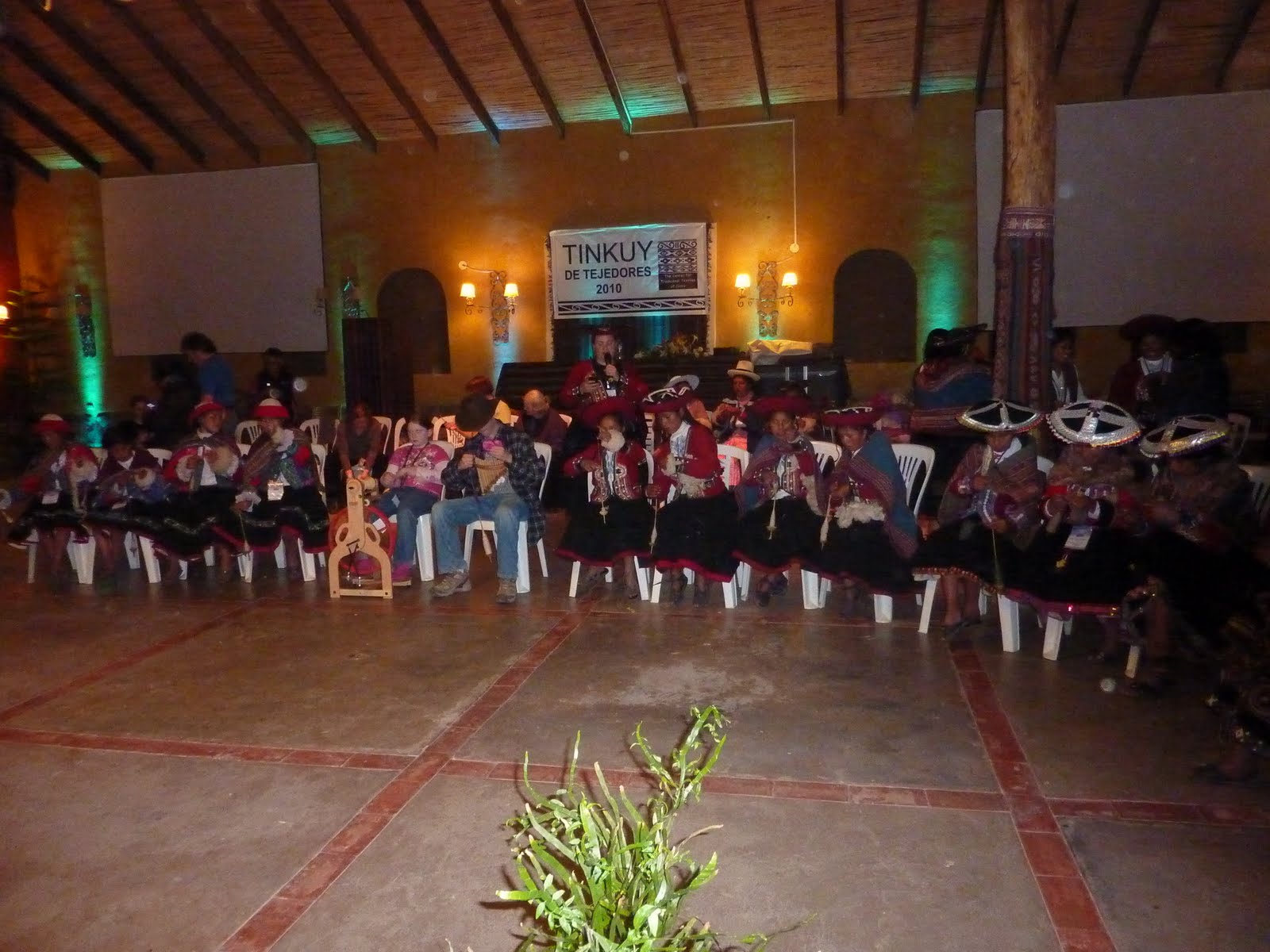
This is the market where I got the carved gourds for my mo and me. They are so beautiful and carved with many symbols and scenes from daily life including weaving and spinning and dancing which are all important parts of life here.The next day was the beginning of the Tinkuy. Two full days of interesting presentations from people all over the Americas. This is a photo of Nilda Callanaupa who is a magical woman who can make miracles happen and who can command all those around her who then serve happily.

The Tinkuy was opened with a beautiful ceremony of offering coca leaves to the earth. Each attendee had an envelope with 3 coca leaves which were put in baskets with a wish for the Tinkuy to be successful. Out wishes were granted. The weather was lovely and the instruction was fantastic.
This was one of my favorite things about lunch. The lines of people with their fantastic clothing. I loved the clothing. LOVED IT!
This woman is from Guatamala and the weaving she is doing is so very complex. Everyone of thoise sticks has string heddles for a different part of her weaving.
This woman is from Equador and is demonstrating a driven spindle. It was beautiful and fluid to watch. Notice all of the prepared fiber.
Maggie was a big hit with all of the weavers. here she tries a spindle belonging to a woman from the Chumbivilcas community in the Cuzco region of Peru. Notice that this wool is only washed. There is no further prep. That is what I saw all over with the spinners. Take note that no expensive tools are necessary to make fantastic yarn that then goes into textiles that last for many, many years.
Abby was beautiful in her Chinchero clothing and she wasted no time to show me that she can ply from a skein. Something that makes me very nervous. I need to practice more.
D.Y. Begay was there from Arizona with her marvelous Navajo spinning and weaving. She did a lovely presentation about Navajo methods of weaving.
This is a teenage weaver from Chinchero...I may get to that width of weaving in a few more years!
The knitting....the knitting...the knitting...so complesx and fine. I took a knitting class and it is very difficult and I have3 lots of practicing to do there too. At some points I was trying to manage 5 colors of yarn at one time.
This man was working on tapestry on his backstrap loom. It was beautiful to watch him work.
At the end of the two days of presentations there was a wonderfully touching closing ceremony where the older weavers in each community passed on their weaving knowledge and tools to the younger generation.
Each night there was a party with contests and dancing and lots of sharing. This was a spinning contest which included all fo the children and Abby's son and Maggie.

And we all danced.

The Chinchero market was colorful and fun but there was class to get to so i didn't get to spend as much time as I wanted to.

There was a natural dye class that looked beautiful when it was over. I was in the knitting class that was so engaging I took no photos.
The next day was a weaving class about circular edgings. While we were warping my second edging there was a hail storm. I wished I was wrapped in all of the wool that my instructor was.
And then there was Machu Picchu.
It wasn't AS scary as Pisac.
A lovely breeakfast that included Chocolate Caliente and fresh Manzanilla (Chamomile) tea
The square in Cuzco city from our breakfast balcony.
And Maggie was able to get some traditional skirts. She looked so cute that the ladies who were weaving at the center wanted to complete her look.
It was a lot of traveling and learning and work. Maggie fell asleep at dinner.
This man is a fantastic knitter. I have a bit of video of him that I will be adding to Youtube shortly.
Maggie got some weaving instruction from many experts - as did I.


And Ryan...We brought him a hat and a Pan Pipe. He was out by the road yesterday with his pipe and hat hoping that if he played people would put money in his hat. I think he gets it from my Mother's side of the family. He was quite disappointed since we live on a not so busy street.

So, while I was in Peru I fell in love. I fell in love with the people. I fell in love with the weavers. I fell in love with the CTTC. I will be in their lives.

I also brought home a massive amount of textiles for the shop as well as a nice selection of Peruvian low whorl spindles. All of these things will be on the webstore as fast as I can list them. We need to preserve this fantastic and complicated and beautiful and useful art by helping and supporting these weavers.

The reality was brought home during this trip that we were within just a few years of all of this being lost. I am not exagerating. We can't lose the knowledge of this. We need to support these people as well as textiles all over the world. Machines cannot do these things. Only talented people who work for years to develop the knowledge.

Peru is beautiful but in the end it was the people who got to me. They are happy and friendly and most loving. Though many are very poor, they are hard working and they share and, not to sound silly, I wish to be more like them.

There is so much more to say but work is calling me from the shop...